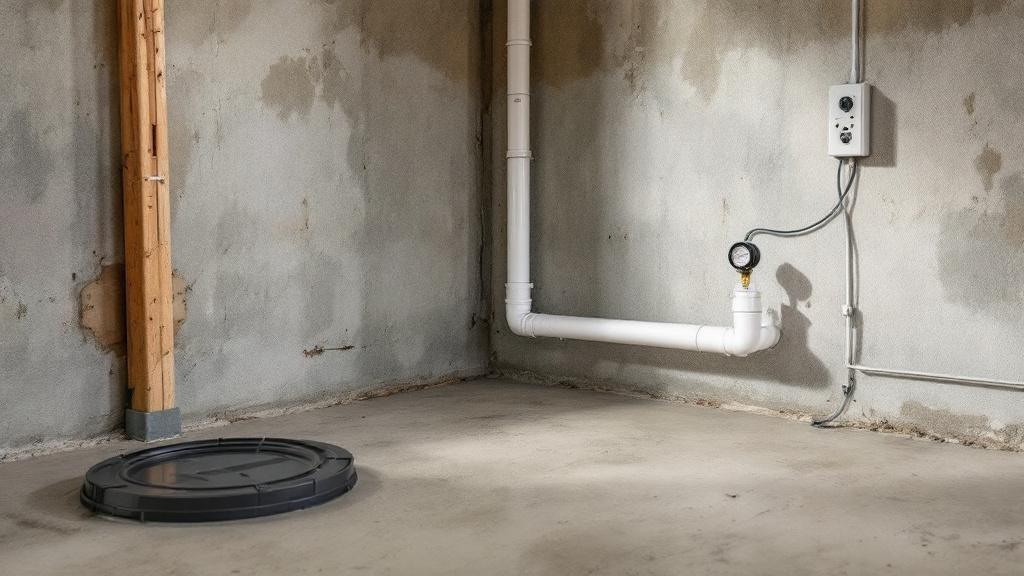
What this service covers
An active sub-slab system sized to the foundation in front of it: a full basement, a walkout, a slab, or the stacked half-levels of a Twin Cities split-entry. Minnesota law requires an MDH license for radon work done for compensation under Minn. Stat. 144.4961, so every install here is performed by a licensed mitigation professional, carries the MDH system tag the state has required on new installs since 2019, and finishes with a verification test once the fan has run.
Typical pricing
$1,400-$2,600
Pricing varies by job specifics. Free phone or on-site quotes; fixed pricing once the technician has assessed the job.
What an active sub-slab system does under a Minnesota basement
Think of the system as a small, permanent change in who wins the pressure contest under your floor. All winter, a heated Twin Cities house acts like a slow chimney: warm air rises and escapes high in the building, and the basement makes up the difference by drawing air from wherever it can, including the soil. The gas in that soil carries radon. A mitigation install drills a suction point through the slab, opens a small pit beneath it, and connects a continuously running inline fan that keeps the soil side of the slab at lower pressure than the basement side. From that day on, soil gas follows the pipe to a discharge above the roofline instead of seeping up through the floor.
The reason this approach dominates is that it treats the cause. Caulking cracks or cracking a window changes the symptom for a while; reversing the pressure gradient removes the driving force. The EPA's consumer guidance rates fan-driven sub-slab suction as the most reliable way to cut indoor radon, far ahead of sealing alone, and MDH points homeowners the same direction.
Minnesota adds a detail worth knowing before any hole is cut. What sits under metro slabs varies street by street: coarse sand in one yard, dense calcareous clay till in the next. The clay moves air poorly, so a house on tight soil sometimes needs a larger pit, a stronger fan, or a second suction point before the whole slab is under control. A diagnostic check of how air moves under the slab, done before the install, is what separates a design from a guess. Our cost guide shows how those findings move the price.
Licensing and the system tag: what Minnesota requires
Minnesota regulates this trade through the Department of Health. Since 2019, Minn. Stat. 144.4961, the Minnesota Radon Licensing Act, has required anyone testing or mitigating for compensation to hold an MDH license, and MDH publishes the list of licensed professionals so a homeowner can check a name before signing anything.
The easiest piece of the law to see with your own eyes is the tag. Every mitigation system installed in Minnesota since January 1, 2019 must carry an MDH system tag, a numbered label fixed to the system itself. Walk into a mechanical room in Woodbury or Maple Grove, find the white pipe with a U-shaped gauge on it, and the tag tells you the install was done under the state program. A pipe with no tag is either older than 2019 or was put in outside the rules, and either way it deserves a closer look before you trust it.
Licensing also shapes the paperwork you should expect: a written scope and price before work starts, the license number of the professional doing the job, and a test after the fan is running to prove the number actually dropped. If a bid is missing any of those, ask why. The one exception in the law worth knowing is that homeowners may test and work on their own house without a license; the moment money changes hands, the license applies. The licensing FAQ covers how to verify a license, and what the tag means covers reading the tag itself.
How metro housing stock shapes the design
A mitigation design that works in one Twin Cities suburb can be wrong two exits down the freeway, because the foundations change with the decade the street was built.
The prewar cores of Minneapolis and St. Paul run on full basements with thick block or stone walls, floors poured in sections long after the house went up, and decades of patched plumbing trenches. Those floors leak soil gas generously and need careful sealing before suction can hold. The first postwar ring, Richfield-style ramblers across Bloomington and the inner edges of Edina, brought shallower basements and tidier slabs that usually mitigate with a single suction point. Then came the split-entry and split-level boom of the late 1960s and 1970s, which filled Coon Rapids, Blaine, Burnsville and half the metro with houses that stack a slab-on-grade half, a lower level four feet down, and sometimes a crawl under an addition. Each foundation section needs its own look, and occasionally its own pipe.
From the 1990s on, Eden Prairie, Lakeville, Woodbury and Plymouth added walkout basements cut into hillsides, poured walls, and, after 2009, a builder's passive radon pipe required by the state building code. A passive pipe is a head start, not a finished system: it often needs a fan once the house is tested. The constant across all of it is the sump basket. Metro clay keeps drain tile and sump systems standard equipment, and an open basket is a direct opening into the soil. Sealing it with a serviceable cover is part of nearly every install here.
What the quote and the closeout should show
Most Twin Cities basement and slab installs land between $1,400 and $2,600. A crawl space that needs a sealed membrane, or a house whose sections call for two suction points, runs higher, and a newer home that only needs a fan on its builder's passive pipe runs lower. The written quote should name the suction point count, the fan model, the discharge route, the sump work, and the sealing scope, so two bids can be compared line by line instead of total against total.
Three items belong in every closeout package in this state. First, the MDH system tag number, which ties the install to the state program. Second, the license number of the mitigation professional who did the work, which you can check against the MDH roster. Third, a post-install test result, because the gauge on the pipe proves the fan is pulling, not that your air is below the action level. The EPA recommends fixing a home at 4.0 pCi/L or more, and the follow-up test is what shows you got there.
Keep all of it with the house records. Minnesota's disclosure law, Minn. Stat. 144.496, requires sellers to hand a buyer their radon records, so a complete folder today becomes a selling point later. Start with the quote checklist in our blog or the calculator for a first range.
Service area
Radon Mitigation Systems is available across Minneapolis, St. Paul and the Twin Cities metro. Per-suburb pages: